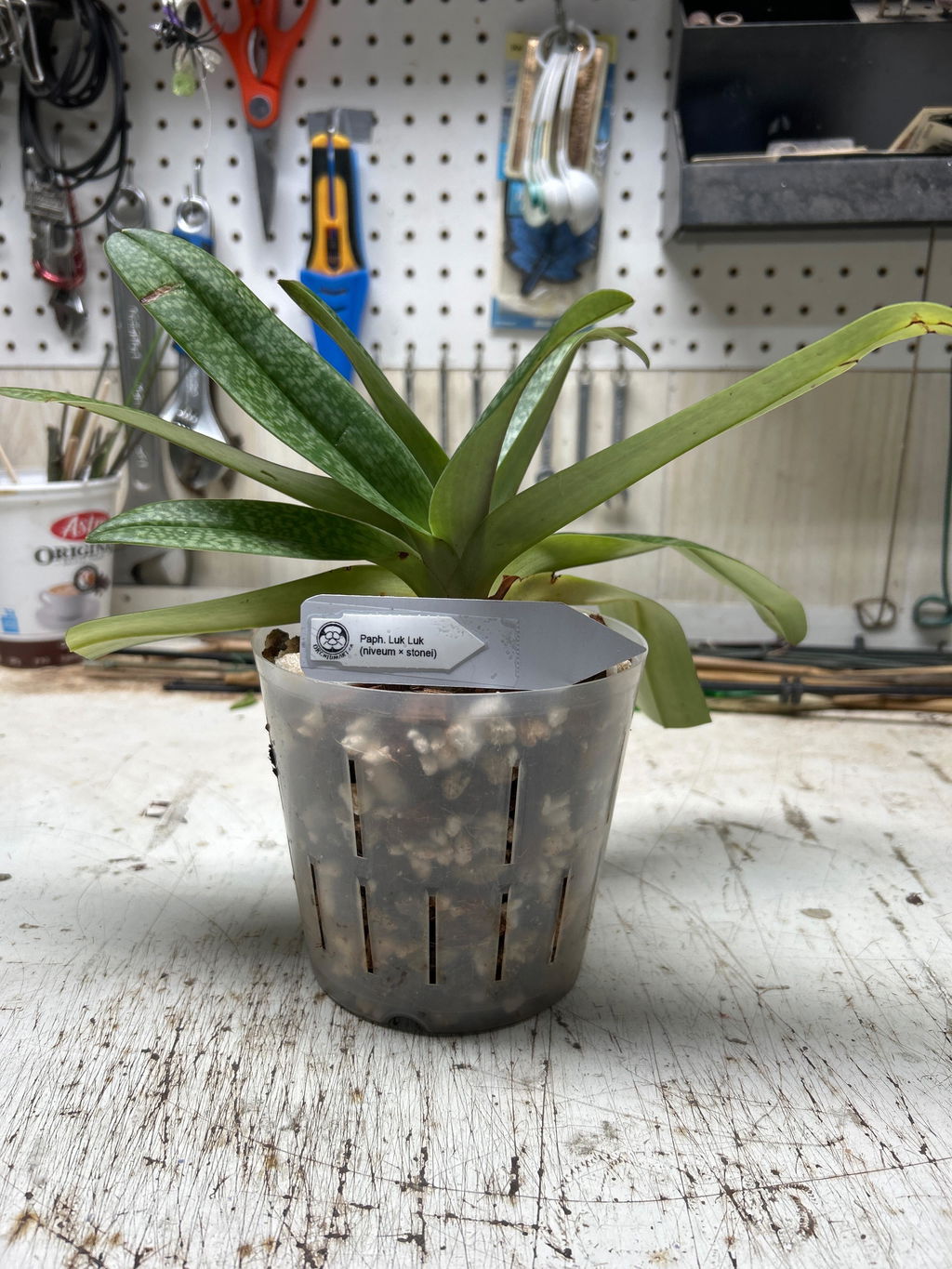
海氏苞葉蘭(本文擬名) Brachycorythis helferi
一種原生於中南半島季節性乾旱林地的地生塊莖蘭——每年隨乾季枯萎、靠地下塊莖度過旱季,命名紀念一位1840年在安達曼群島殉職的博物學家,而牠自己也是一個直到2010年才被拆解的「物種複合群」

orchidmart.ca/blogs/caresheet
orchidmart.ca/blogs/caresheet
| 1 | 2 | 3 | 4 | 5 | 6 | 7 | 8 | 9 | 10 | 11 | 12 | |
|---|---|---|---|---|---|---|---|---|---|---|---|---|
| 日溫 | 29 | 31 | 34 | 35 | 32 | 31 | 30 | 30 | 30 | 29 | 29 | 27 |
| 夜溫 | 13 | 15 | 19 | 22 | 23 | 23 | 22 | 22 | 22 | 20 | 17 | 14 |
- 命名紀念一位在牠被命名32年前就已過世的博物學家。種小名 helferi 紀念 Johann Wilhelm Helfer(1810–1840),一位受雇於東印度公司、調查緬甸丹那沙林與丹老群島(Mergui)的博物學家。1840年初,他在安達曼群島與當地原住民接觸時遭箭射身亡,遺體始終沒有尋獲。本種直到1872年才由 Reichenbach 命名,此時 Helfer 已過世32年。
- 83年內用過五個屬名。1872年發表時叫 Gymnadenia helferi,之後依序改為 Habenaria helferi(1890)、Platanthera helferi、Phyllomphax helferi(1919),直到1955年才安定在現行的 Brachycorythis helferi。屬名(1838年 Lindley 發表)源自希臘文「短」(brachys)加「頭盔」(korys)——不同來源對「頭盔」指唇瓣或中萼片與花瓣合成的罩狀構造說法不一,本文兩種並陳。
- 牠其實是五個物種擠在一個名字底下,直到2010年才被拆開。一篇2010年形態計量研究發現,過去通稱 B. helferi 的標本其實涵蓋五個獨立物種,未開花時幾乎無法可靠區分。查證 RHS 國際蘭花登錄資料庫,本種查無任何登錄雜交紀錄——就現有紀錄而言仍是未經登錄雜交的野生種。
Brachycorythis helferi — Full Care Guide
This is a plant with two stories layered on top of each other: a tragic naming history, and a taxonomic identity crisis that wasn't resolved until 2010. It's also a genuinely obscure terrestrial orchid in cultivation — which means this guide leans harder than usual on inference from habitat and from a related genus, and says so plainly wherever it does.
A Name Honoring a Life Cut Short — and Five Genus Names in 83 Years
The species epithet commemorates Johann Wilhelm Helfer (1810–1840), a Prague-born naturalist employed by the British East India Company to survey Tenasserim and the Mergui Archipelago (now southern Myanmar) from the late 1830s. In early 1840, while making contact with Andaman Islanders, he was shot and killed; his body was never recovered. The orchid wasn't described until 1872, by Heinrich Gustav Reichenbach — 32 years later. Reichenbach placed it in Gymnadenia; it then moved through Habenaria (Hooker, 1890), Platanthera, and Phyllomphax (Schlechter, 1919), before Summerhayes settled it into the currently accepted Brachycorythis in 1955 (Kew Bulletin). The genus name, coined by Lindley in 1838, combines Greek brachys ("short") with korys ("helmet") — sources disagree whether that means the hooded lip or the hood formed by the dorsal sepal and petals, and this guide presents both readings.
A Species Complex: What You May Actually Be Buying
Here's the part that matters most for a buyer. A 2010 morphometric study (Pedersen, Bot. J. Linn. Soc. 162: 64–76) found that what had long been lumped together as B. helferi actually comprises five species: B. henryi, B. neglecta (new in that paper), B. helferi sensu stricto, B. laotica, and B. acuta — very difficult to tell apart without flowers. A plant sold as B. helferi could plausibly be one of its close relatives instead. Reassuringly, these segregate species share very similar ecology — seasonally dry tropical forest, tuberous dormancy — so the care advice here should hold reasonably well across the complex.
Fire, Bamboo and a Seasonally Dry Forest Floor
This terrestrial, tuberous geophyte sits in a seasonally dry tropical biome (POWO), and herbarium labels — many from J.F. Maxwell's Thailand collections — repeatedly describe mixed deciduous hardwood forest, bamboo stands, and open grassland, often noting the site as "fire-damaged" or "degraded." That suggests a plant tolerant of a landscape that regularly burns and regrows, rather than a shade-loving, undisturbed-forest specialist (an inference from the labels, not a documented finding). Substrate records vary widely — metamorphic sandstone in Cambodia, shale in Laos, limestone around Kanchanaburi and Phangnga — arguing against treating it as a limestone specialist despite some well-documented limestone sites. No source calls for raising the medium's pH.
A Scattered Range Across Mainland Southeast Asia
POWO's accepted range runs from Assam, Bangladesh, and Cambodia through Laos, Myanmar, Thailand, Vietnam, to Yunnan (China). This guide draws a narrower, more conservative picture based on what GBIF specimens actually corroborate: a confirmed core across northern/western Thailand, peninsular Thailand, Myanmar, Laos, and northeastern India (Assam/Meghalaya) — detailed in the Origin field above. Cambodia rests on a single Mekong locality, treated as an isolated point; Vietnam and Yunnan lack corroborating specimens; Bangladesh has only a literature record (see the Origin field for sourcing on all three). Elevation runs roughly 30–1,200m, concentrated at 250–700m — one hobby site's 1,600m ceiling couldn't be traced and is flagged as unverified.
Warm Nights, a Dry Rest — Not a Cold Dormancy
No source directly documents this species' temperature tolerance, and the two references that exist disagree: orchidspecies.com calls it tolerant of "hot to cool" conditions, while AOS's genus page describes "intermediate to cool-intermediate" — a spread that likely reflects its wide elevation range (30–1,200m) rather than a contradiction. Lampang, Thailand climate data (see the Temperature field and monthly chart above) suggests growing-season days around 29–32°C, nights 20–23°C, with a cooler November–January spell (13–17°C nights) and a hot, dry March–April peak (34–35°C) before the rains return. A dormant tuber is unlikely to resume growth just because the air has warmed; it's waiting for moisture, not heat. Ordinary room temperature is fine during dormancy (native dry-season nights run roughly 13–22°C) — dryness matters more than temperature; just avoid long stretches below 10°C (a cultivation inference, not a species-specific measurement) — the natural cool spell is an ordinary dry-season feature, not something to engineer. In a Canadian home or greenhouse, this plant needs to stay indoors or under glass year-round.
Light, Media and Water Through the Year
Light recommendations are broad and inferred: "part sun" per orchidspecies.com, "bright light" per AOS — consistent with open grassland and the dappled light of leafy deciduous/bamboo forest, roughly 20,000–35,000 lux (Cattleya-to-bright-Phalaenopsis territory), borrowed by analogy from the related tuberous genus Habenaria rather than documented directly. For media, AOS's only guidance — "sandy loam" — comes with no pH preference, and given this species' varied substrate (sandstone, shale, limestone), this guide doesn't recommend adding lime; a loose, free-draining mix on the Habenaria model (coir/peat base, perlite or coarse sand, fine bark or charcoal, a little chopped sphagnum) is a reasonable start. A newly arrived, imported dormant tuber should be watered by its own state, not the calendar (see Watering above); once established, water generously through the season without going soggy, then taper as leaves yellow. Once fully dormant, growers in the related genus split into two camps — withhold water entirely, or mist lightly once a week — with no documentation settling which suits this species better; a cautious middle ground is a reasonable default.
Feeding, Fragrance, and the Honest Gaps
Fertilizing guidance is similarly thin: the closest source, again Habenaria literature, mentions only "light feeding" with no specific dose. A reasonable default is a balanced orchid fertilizer diluted to quarter/half strength, applied every second or third watering during active growth, stopped as leaves yellow. Fragrance is a complete blank — none of the sources checked (POWO, Flora of China, orchidspecies.com, Pedersen 2010, the Laos checklist) mention scent, and a grower forum thread that might have said more couldn't be accessed, so this guide records it as undocumented rather than guessing. Worth saying plainly: this is one of the more data-sparse species in this series, and the temperature, media, and dormancy sections lean heavily on climate inference and on the analogous genus Habenaria rather than direct observation.
海氏苞葉蘭養護全解(「海氏苞葉蘭」為本文擬名)
這株植物疊了兩層故事:一段帶著悲劇色彩的命名史,加上一個直到2010年才真正釐清的物種身分懸案。牠在栽培圈也確實相當冷門——這表示這篇文章比平常更依賴從棲地與近緣屬推算而來的資訊,而且每一處推論都會老實標明。
命名紀念一位早已過世的博物學家,83年內用過五個屬名
種小名 helferi 紀念 Johann Wilhelm Helfer(1810–1840),一位出身布拉格、受雇於英國東印度公司的博物學家,1830年代後期奉派調查緬甸丹那沙林與丹老群島(Mergui)一帶的自然資源。1840年初,他在安達曼群島與當地原住民接觸時遭箭射身亡,遺體始終未被尋獲。這株蘭花直到1872年才由 Reichenbach 發表——此時 Helfer 已過世32年。Reichenbach 發表時放在 Gymnadenia 屬,之後依序移入 Habenaria 屬(Hooker,1890)、Platanthera 屬、Phyllomphax 屬(Schlechter,1919),直到1955年 Summerhayes 在《Kew Bulletin》發表新組合才安定在現行的 Brachycorythis 屬。屬名由 Lindley 於1838年發表,由希臘文「短」(brachys)加「頭盔」(korys)組成——不同來源對「頭盔」指的是唇瓣還是中萼片與花瓣合成的罩狀構造說法不一,本文兩種說法並陳。
牠其實是五個物種,直到2010年才被拆開
這是對消費者最實際的一點。2010年一篇形態計量研究(Pedersen,《Bot. J. Linn. Soc.》162: 64–76)發現,過去統稱為 B. helferi 的標本其實涵蓋五個獨立物種:B. henryi、B. neglecta(該論文新發表)、狹義的 B. helferi、B. laotica 與 B. acuta——未開花的植株很難可靠鑑定到種。這意味著市售標示為 B. helferi 的植株,實際上有可能是複合群裡的其他近緣種;好消息是這幾個種生態習性非常接近,養護邏輯應該不會因物種身分不同而有太大差異。
野火、竹林與季節性乾旱的林地
本種是地生、塊莖型地下芽植物,POWO 將其歸類在季節性乾旱熱帶生物群系。多筆標本標籤(不少來自植物學家 J.F. Maxwell 在泰國的採集)反覆描述棲地為落葉混交硬木林、竹林與開闊草地,常註明「曾受火燒」「林相退化」——顯示牠不是需要未受干擾原始林蔭的嬌貴植物,而是適應週期性野火、重新生長的林地環境。基質紀錄也相當多樣:柬埔寨變質砂岩、寮國頁岩、泰國北碧府與攀牙一帶石灰岩皆有紀錄,並非石灰岩專性植物,查無文獻建議額外提高介質 pH。
橫跨中南半島的破碎分布
POWO 接受的分布橫跨阿薩姆、孟加拉、柬埔寨、寮國、緬甸、泰國、越南與中國西南(雲南)。本文採用更保守的呈現方式,只畫出真正有 GBIF 標本佐證的核心範圍:泰國北部與西部、泰國半島南部、緬甸、寮國與印度東北阿薩姆/梅加拉亞邦(詳見上方「產地」欄位)。柬埔寨僅有上丁省湄公河沿岸單一地點的標本,視為單點紀錄;越南與雲南查無標本佐證;孟加拉僅有文獻新紀錄(出處詳見「產地」欄位)。已知海拔集中在約30–700公尺;orchidspecies.com 記載上限達1600公尺,但查無可靠出處,僅列為單一來源參考。
溫暖但乾燥的休眠,不是低溫休眠
沒有任何文獻直接記載本種的溫度數據,orchidspecies.com 與美國蘭花學會(AOS)屬級頁面兩個來源還互相矛盾——前者寫「從熱到冷都能適應」,後者寫「中溫到偏冷中溫」,落差可能反映本種海拔跨度(30–1200公尺)本身就很大。本文以南邦(Lampang,位於分布核心區)氣候資料推算(詳見上方溫度欄位與逐月表):生長季日溫約29–32°C、夜溫約20–23°C;乾季前段夜溫轉涼至約13–17°C,後段日溫回升到全年最熱的34–35°C,雨季則要到4–5月才真正降臨。休眠中的塊莖不會因氣溫回暖就提早甦醒,牽動發芽的是水分而不是溫度。休眠期一般室溫即可(原生地乾季夜溫約13–22°C),重點是保持乾燥;避免長期低於10°C(屬栽培推論,非本種實測);自然低溫是正常乾季現象,不必刻意營造。在加拿大,這株植物全年都必須待在室內或溫室。
光照、植料與全年澆水邏輯
光照建議同樣寬泛且多屬推論:orchidspecies.com 寫「半日照」,AOS 屬級頁面寫「明亮光線」,推算約20,000–35,000 lux,大致是嘉德麗雅蘭到偏亮蝴蝶蘭的程度——借用玉鳳花屬類比推算,非本種實測。植料方面,AOS 唯一方向是「砂質壤土」,查無 pH 偏好文獻;考量本種基質橫跨砂岩、頁岩與石灰岩,本文不建議額外加石灰。比照玉鳳花屬配方,建議以排水良好的礦物質為主、混入部分保濕有機質:椰纖或泥炭盆栽土、珍珠石或粗砂、細樹皮或木炭,加少量剪碎水苔。收到的進口休眠塊莖請依塊莖狀態澆水,不要照月份操課(詳見「澆水」欄位)。穩定生長後均勻濕潤、不可積水,入秋轉黃後逐步減水。完全休眠後的做法栽培圈目前分兩派——斷水或每週表面輕噴,本文建議新手採「幾乎斷水、偶爾輕噴」的折衷做法。
施肥、花香與誠實的資料空白
施肥資料同樣稀少,唯一可類比的玉鳳花屬文獻僅提到生長季「輕度施肥」,無具體濃度。本文依地生蘭通用做法建議:僅生長季施肥,均衡型蘭花肥稀釋至1/4–1/2,每2–3次澆水施一次,葉片轉黃即停肥。花香欄位完全空白——已查閱的資料來源(POWO、《Flora of China》、orchidspecies.com、Pedersen 2010、寮國蘭科名錄)都沒有提到香氣,本文誠實標註「未見記載」。值得坦白說明:這是本系列資料最稀少的物種之一,溫度、植料與休眠管理幾個欄位相當依賴氣候推算與近緣屬類比,而非直接觀察。
Brachycorythis helferi (Rchb.f.) Summerh., 1955
A tuberous terrestrial orchid of seasonally dry forest across mainland Southeast Asia — named for a naturalist killed 32 years before the plant itself was described, and belonging to a species complex not sorted out by botanists until 2010
orchidmart.ca/blogs/caresheet
orchidmart.ca/blogs/caresheet
| 1 | 2 | 3 | 4 | 5 | 6 | 7 | 8 | 9 | 10 | 11 | 12 | |
|---|---|---|---|---|---|---|---|---|---|---|---|---|
| High | 29 | 31 | 34 | 35 | 32 | 31 | 30 | 30 | 30 | 29 | 29 | 27 |
| Low | 13 | 15 | 19 | 22 | 23 | 23 | 22 | 22 | 22 | 20 | 17 | 14 |
- Its name honors a naturalist who died 32 years before the plant was described. The epithet helferi commemorates Johann Wilhelm Helfer (1810–1840), a Prague-born naturalist surveying Tenasserim and the Mergui Archipelago for the East India Company. In early 1840 he was shot and killed by Andaman Islanders while making contact with them; his body was never recovered. The orchid wasn't formally described until 1872, by Reichenbach.
- Five genus names in 83 years. First published as Gymnadenia helferi in 1872, it moved through Habenaria (1890), Platanthera, and Phyllomphax (1919) before settling into the currently accepted Brachycorythis in 1955. The genus name, coined by Lindley in 1838, combines Greek for "short" and "helmet" — sources disagree whether that means the lip or the hood formed by the dorsal sepal and petals.
- It's actually five species hiding under one name, only sorted out in 2010. A morphometric study that year found specimens long lumped together as B. helferi represent five distinct species, nearly very difficult to tell apart without flowers. A search of the RHS International Orchid Register turns up no registered hybrids for this species — as far as the record shows, none have been registered.


Notes: AOS's genus-level guidance calls for "sandy loam" — these two items (bark, perlite) are drainage/aeration components to combine with potting soil or coarse sand to approximate that texture, not a ready-made formula. No lime or dolomite is included — this species' substrate record spans sandstone, shale and limestone, and no source calls for raising the mix's pH.