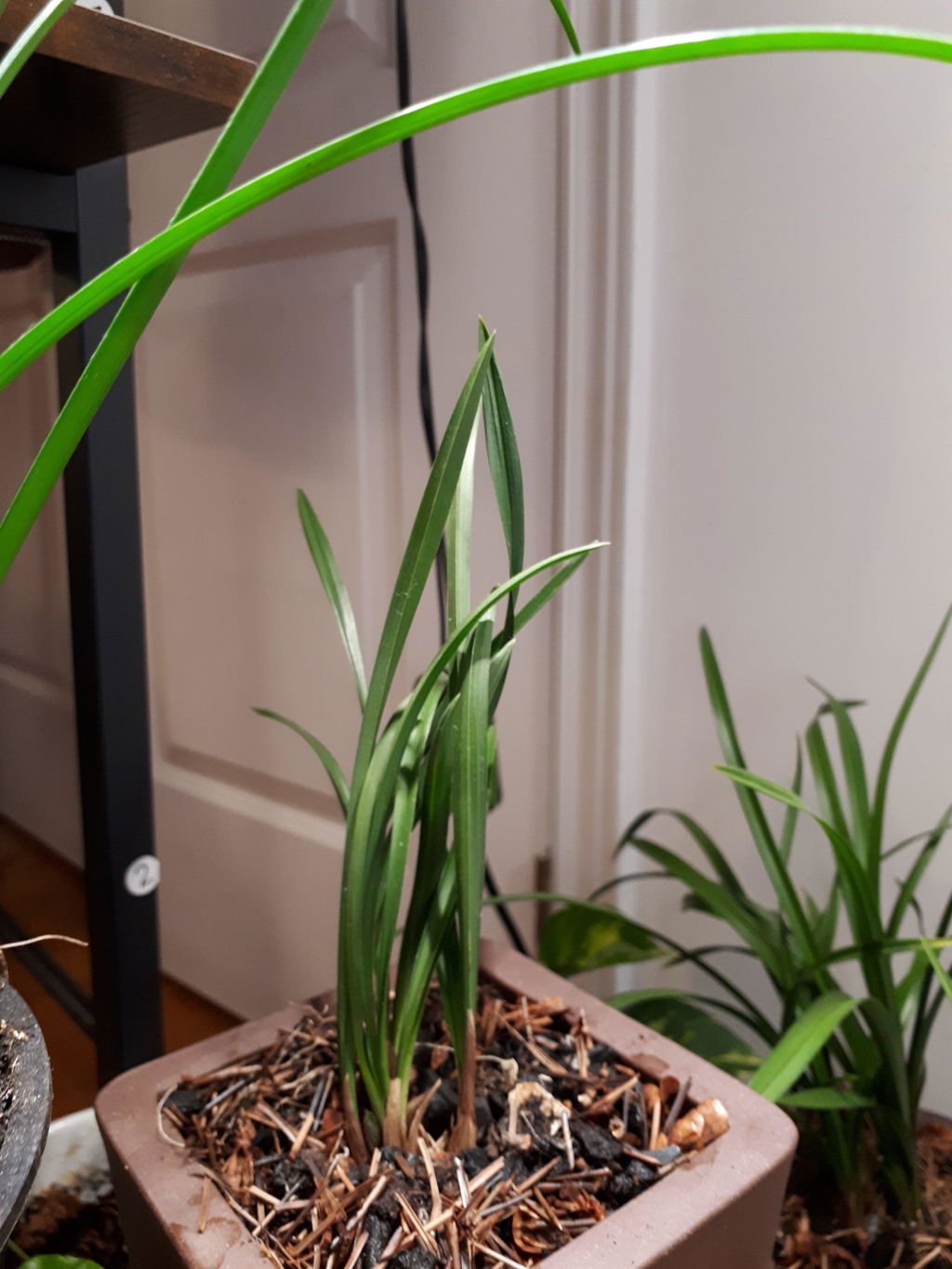
台灣香蘭(哈兒蘭)Haraella retrocalla (Hayata) Kudô 1930
指甲蘭亞族 · 現行學名 Gastrochilus retrocallus · 台灣特有種 · 迷你附生蘭


orchidmart.ca/blogs/caresheet
orchidmart.ca/blogs/caresheet
| @1,011m | 1 | 2 | 3 | 4 | 5 | 6 | 7 | 8 | 9 | 10 | 11 | 12 |
|---|---|---|---|---|---|---|---|---|---|---|---|---|
| 日溫 | 19 | 20 | 22 | 24 | 26 | 27 | 28 | 28 | 27 | 26 | 24 | 21 |
| 夜溫 | 11 | 12 | 14 | 16 | 19 | 20 | 20 | 20 | 20 | 18 | 16 | 13 |
- 一株沒有產地的模式標本,和繞了一圈回到原點的學名:1914 年早田文藏依據一株在台北溫室開花、原產地不明的個體發表為 Saccolabium retrocallum;1917 年早田文藏本人移入盆距蘭屬,成為 Gastrochilus retrocallus;1930 年工藤祐舜另立新屬 Haraella,以採集並栽培開花、提供另一批模式材料的日籍人士原氏(Y. Hara)命名紀念他,種小名 retrocalla 則指唇瓣上反摺的肉突形態。2024 年一項全葉綠體基因體分子研究支持應併回盆距蘭屬的主張,Kew 等國際名錄現已採用現行學名 Gastrochilus retrocallus——正是早田文藏 1917 年用過的同一個組合;台灣學界與蘭花市場則仍普遍沿用較為人熟知的舊名 Haraella retrocalla,本篇亦以此為主要稱呼。
- 猴臉與三唇瓣:花朵偶爾被栽培者形容像猴子臉,這個視覺效果主要來自唇瓣中央密生絨毛的紫紅色大斑塊與流蘇狀邊緣,並非正式的分類特徵。市面上另有「Three Lip 三唇瓣」品系,是栽培選拔出的花部突變個體,不是正式變種。查證 RHS 國際蘭花雜交登錄資料庫,本種歷來只有一筆登錄雜交——2005 年登錄的跨屬雜交 Gastronopsis Nanzhi Pink(Phalaenopsis Wedding Promenade × Gastrochilus retrocallus),市售個體幾乎都是原生種實生苗或組培苗,不是雜交種。
- 兩個看似相反的死因,其實是同一個原因:根部長期乾燥、以及悶濕不通風導致爛根,是本種最常見的兩種失敗,看似矛盾,實則都源自幾乎沒有儲水構造這個特性——上板植株需要接近每天澆水,同時又需要良好的空氣流通讓根系「快乾但不全乾」,而不是像有些附生蘭靠假球莖撐過疏忽。
The Orchid Whose Genus Came Full CircleHaraella retrocalla — Full Care Guide
Tap the 🔊 beside any heading to listen to that section.
A flower barely two centimetres across — shaped, depending who you ask, like a tiny monkey's face — has spent over a century moving through three different genus names, the latest move landing it right back where it started. The taxonomy turns out to matter less than one practical fact: this miniature Taiwanese epiphyte wants almost nothing in common with the hardy Cypripedium featured elsewhere on this site. It needs no cold winter rest.
A specimen with no return address
In 1914 the botanist Bunzō Hayata described a small orchid that had flowered in a greenhouse in Taipei. Its wild origin was never recorded — no collecting locality, no habitat note, just a plant that bloomed where someone could see it. He published it as Saccolabium retrocallum. In 1917 Hayata himself moved it into Gastrochilus, the genus of "pouch orchids" distinguished by a saccate lip, as Gastrochilus retrocallus. In 1930 the Taihoku Imperial University botanist Yushun Kudô looked more closely at the lip — this species has no true pouch, just a recurved callus — and split it into a genus of its own, Haraella, naming it for Y. Hara, a collector credited with bringing separate material of this orchid into flower; Kudô used that material to describe a second name, Haraella odorata, in the same 1930 paper that recombined Hayata's species as Haraella retrocalla — the two names were later recognized as the same plant, with odorata folded in as a synonym. The species name retrocalla simply describes the recurved callus on the lip.
Back to Gastrochilus, a century later
Taxonomy has kept moving. A 2024 whole-plastome molecular study placed this species as the earliest-diverging lineage within Gastrochilus — essentially a sister to the rest of the genus rather than something separate from it (an earlier 2019 study had instead nested it within the related genus Pomatocalpa, so the molecular picture isn't unanimous). Kew's Plants of the World Online and GBIF's backbone taxonomy now both list Gastrochilus retrocallus as the accepted name, with Haraella retrocalla downgraded to a synonym — which means the currently accepted name is the same combination Hayata himself published back in 1917, before Kudô ever split off Haraella. Taiwan's own databases and the international orchid trade have not caught up — Haraella retrocalla is still what you will find on nursery tags and in Taiwanese botanical literature, and it is the name this care sheet leads with. If you see either name on a label, they refer to the same plant.
An island-wide address, not a single mountain
Unlike many of the narrow-range species documented on this site, this one is recorded right across Taiwan's mid-elevation forest belt — from Wulai and Nan'ao in the north down through Lugu and Shanping to Shizi in the south, with populations on both the western and eastern flanks of the island. Published elevation figures disagree (one widely cited source gives 1,000–2,200 m, which skews well above where Taiwanese herbarium specimens actually sit), but the 18 specimen records with elevation data that we could check span roughly 415–1,200 m and cluster mostly at 700–1,200 m, in humid broadleaf forest with intact canopy and constant moisture — stream banks and ridgelines.
Taiwan's own red-list assessment currently places it as Near Threatened, a step down from an earlier Vulnerable rating noted in a 2008 Forestry Bureau survey. It is not legally protected, and wild collection for sale as potted plants in local flower markets put pressure on some populations before lab-propagated seedlings became widely available — one more reason to buy nursery stock rather than wild-collected material.
No winter required
Here is the one instruction worth repeating in bold: this species does not need a cold rest to flower. If you have read the Cypripedium care sheets on this site, you know those hardy terrestrial slipper orchids demand roughly three to four months near 0–5°C before they will bud properly the following spring — skip that chilling and they often fail to bloom (a Swedish nursery lost ~400 plants after one mild winter). Haraella is the opposite case. It grows continuously, with no true dormant season, and under warm, steady conditions it will flower more or less whenever it is ready rather than on a fixed annual cue. In the wild, flowering concentrates mainly from July to November; in a warm growing area it often blooms sporadically year-round.
Aim for roughly 18–28°C by day with nights running 5–8°C cooler. It tolerates a wider swing than that for short periods — reports range from about 10°C up to the low 30s°C — but avoid letting it sit below 10°C, and never let it freeze. The more dangerous combination is sustained heat paired with dryness, since this plant has almost no reserves to draw on.
Mounted, or potted — the honest trade-off
Growers mount this species on cork, tree fern or driftwood, with a thin pad of sphagnum tucked around the root ball, and that is probably closest to how it actually grows in the wild, clinging to bark inside humid, intact-canopy forest. The catch is that a mounted plant needs watering close to every day. If that is not realistic for you — if you are away often, or your home air runs dry — a small pot of pure sphagnum, or sphagnum mixed with a little fine bark, buys you more margin for error. Neither approach is wrong; they are simply different answers to how much daily attention you can give it.
Water like it has no reserves, because it doesn't
This is the detail that explains almost every failure report we found. Haraella has no pseudobulb and essentially no water-storage tissue anywhere in the plant. A mounted specimen left dry for even a few days too long will shrivel, though resumed watering can revive it. At the same time, roots sitting in constant moisture with poor air movement rot just as readily — this plant does not tolerate standing water around its roots for long. The target is a fast wet–dry cycle: water thoroughly, let it approach dryness, then water again — daily for mounts, every two to three days for pots — rather than either extreme.
Feed weakly, flush often
A general orchid fertiliser at a quarter to half the label strength, applied weekly or every other week through the growing season, is as far as the available grower accounts go — there is no evidence this species wants or tolerates a heavier feeding regime than any other miniature epiphyte. Mist the solution onto mounted roots directly, and flush periodically with plain water so salts don't accumulate in a small root mass.
The scent you might not get
Most descriptions mention a light citrus or lemon-toned fragrance, and some growers report it as noticeably stronger than others do — reports vary, possibly with the individual plant or its growing conditions (one source suggests brighter light may bring out more scent, though that's not confirmed elsewhere). We found no reliable source saying whether the scent is stronger by day or by night, so this sheet makes no claim either way. If fragrance is the reason you're buying one, treat it as a pleasant possibility rather than a guarantee.
The monkey face, the three-lipped mutant, and the one hybrid that exists
The "monkey face" nickname comes entirely from the lip: a velvety, near-black-maroon central blotch surrounded by a fringed margin, braced by the pale yellow-white sepals and petals above it. It is a grower's description, not a scientific one. A 'Three Lip' form sometimes offered in the trade — where mutated petals take on lip-like texture and colour — is a selected individual carrying a floral mutation, not a named botanical variety; treat the label as a cultivar description, not a taxon. And for anyone wondering whether what they're buying might secretly be a hybrid: checking the RHS International Orchid Register turns up exactly one registered cross using this species as a parent in over a century of record-keeping — Gastronopsis Nanzhi Pink, registered in 2005. Outside that single example, a plant sold as Haraella retrocalla is almost certainly the species itself.
Why it's worth the daily watering
It is small enough to fit a windowsill tray or a well-ventilated terrarium shelf where a full-sized epiphyte never could, distinctive enough that nobody mistakes it for another orchid once they've seen the lip up close, and — unlike the deciduous, cold-dependent Cypripedium this site also covers — it rewards attention on almost any day of the year rather than making you wait for one precise spring moment. Get the watering rhythm right, and the rest of its care asks very little.
一種學名繞了一圈又回到原點的蘭花Haraella retrocalla — 養護全解
點各小標題後的 🔊 可聆聽該段。
一朵不到兩公分的花,有花友形容花形像一張迷你猴臉,卻在一百多年間先後換過三次屬名,最後一次改動又剛好繞回最初的落點。分類學上的糾結,重要性其實遠不及一個實用的事實:這種台灣迷你附生蘭,跟本站其他幾篇杓蘭文章要求的養法幾乎完全相反——它不需要經過低溫的冬天。
一株沒有產地的模式標本
1914 年,植物學家早田文藏發表了一株在台北某處溫室裡開花的小型蘭花——沒有採集地點,沒有棲地紀錄,只有一株剛好在有人看見時開了花的植物。他將它發表為 Saccolabium retrocallum。1917 年早田文藏本人將其移入以唇瓣具囊袋為特徵的盆距蘭屬 Gastrochilus,成為 Gastrochilus retrocallus。1930 年,台北帝國大學的工藤祐舜仔細檢視了唇瓣——發現本種其實沒有真正的囊袋,只有一塊反摺的肉突——於是另立新屬 Haraella,以採集並栽培開花、提供另一批模式材料的原氏(Y. Hara)命名紀念他;工藤同一篇論文裡,依原氏的材料另外發表了 Haraella odorata,並把早田文藏的物種移入新屬成為 Haraella retrocalla——這兩個名字後來被認定是同一種植物,odorata 併為異名。種小名 retrocalla 說的正是那塊反摺的肉突。
一百年後,又被併回盆距蘭屬
分類學至今仍在修正。2024 年一項全葉綠體基因體分子研究發現,本種其實是盆距蘭屬中最早分支出來的一支——本質上是屬內其餘物種的姊妹群,而不是另一個獨立的支系(先前2019年一項研究則把本種歸入另一個近緣屬 Pomatocalpa,兩者結論並不一致)。Kew 的 POWO 與 GBIF 的骨幹分類現已採用Gastrochilus retrocallus 作為現行接受名,Haraella retrocalla 則降為異名——也就是說,現行接受的學名組合,正是早田文藏本人早在工藤祐舜另立 Haraella 屬之前、1917 年就已發表過的那個組合。台灣本地的資料庫與國際蘭花市場都還沒跟上這個改變——苗場標籤與台灣本地文獻依然普遍沿用 Haraella retrocalla,本篇也以此為主要稱呼。若您在標籤上看到任一名字,指的都是同一種植物。
全島皆有,不是單一山頭
與本站介紹過的許多狹域特有種不同,這一種在台灣中海拔森林帶幾乎全島都有紀錄——北起烏來、南澳,中經鹿谷、扇平,南抵獅子,東西兩側山系皆有紀錄(惟目前查無族群監測數據,無法確認是否穩定)。文獻記載的海拔範圍分歧不小(有一份常被引用的資料給出 1,000–2,200 米,明顯高於台灣本地已知標本的分布),查證 18 筆有海拔座標的標本紀錄,實際範圍約 415–1,200 米,多數集中在 700–1,200 米之間,生長於林相完整、水氣常年充沛的濕潤闊葉林中——溪谷兩岸、稜線這類即使沒下雨也始終濕潤的地方。
台灣現行的紅皮書評估將本種列為接近受脅,比先前易危的等級下修了一級。它並非法定保護物種,但數十年來因花市採集對部分族群造成的壓力確實存在,直到組培苗普及後才緩解——這也是為什麼選購時建議優先考慮人工繁殖個體,而非來源不明的野採植株。
不需要冬天
這是整篇文章中最值得反覆強調的一點:本種不需要低溫休眠就能開花。如果您讀過本站的杓蘭(Cypripedium)系列文章,會知道那些耐寒地生蘭必須經歷約三到四個月、接近 0–5°C 的低溫才會在隔年春天正常萌芽開花——少了這段春化,輕則不開花,重則植株死亡(曾有瑞典苗場一個暖冬後損失約400株)。Haraella 剛好相反:它全年持續生長,沒有真正的休眠期,在溫暖穩定的環境下幾乎隨時可能開花,而不是依照固定的年度週期。野外主要花期集中在 7–11 月;栽培偏暖時則常全年陸續開花。
生長季日溫以 18–28°C 為目標,夜溫再低 5–8°C。短時間能承受更大的溫差——回報範圍從約 10°C 到 30 幾度不等——但應避免長期低於 10°C,更不可受凍。更危險的組合是「持續高溫又同時乾燥」,因為這種植物幾乎沒有任何儲備可以支撐。
上板或小盆:誠實的取捨
栽培者多半把它上板(蛇木板、軟木或漂流木,根球周圍包一層薄薄的水苔),這大概最接近它在野外附生於通風林木上的真實樣貌。代價是上板植株需要近乎每天澆水。如果這對您不太實際——經常不在家,或居家空氣偏乾——改用純水苔小盆,或水苔混一點細樹皮,會給您更多犯錯的餘裕。兩種做法都沒有錯,差別只在於您能給它多少日常關注。
澆水:它真的沒有儲備
這大概是解釋大部分失敗案例最關鍵的一個細節。Haraella 沒有假球莖,植株幾乎沒有任何儲水組織。上板植株只要乾放久個幾天,就會開始皺縮,不過恢復澆水後通常能回復。但另一方面,根系長期泡在潮濕又不通風的環境裡一樣容易腐爛——這種植物不能讓根部長期泡水。目標是快速的乾濕循環:澆透、接近乾燥、再澆——上板每天、盆植每兩到三天——而不是走向任何一個極端。
施肥:薄肥勤施
生長季以一般蘭花肥的四分之一到二分之一濃度,每週或隔週施用一次,是目前查到的栽培者經驗能支持的範圍——沒有證據顯示本種需要或能耐受比其他迷你附生蘭更重的施肥量。上板植株可直接把肥液噴在根部,並定期以清水沖洗,避免小根團累積鹽分。
關於香味:不是每株都有
多數描述提到淡淡的柑橘或檸檬調香氣,部分栽培者回報明顯比其他人強烈——回報不一,可能與個別植株或栽培環境有關(有來源提到光照較強可能讓香氣更明顯,但未見其他來源佐證)。我們查無可靠來源說明香氣是日間還是夜間較濃,本篇對此不做任何斷言。如果您買它是衝著香味去的,請把它當成一個令人愉快的可能性,而不是保證。
猴臉、三唇瓣突變,以及唯一存在的雜交種
「猴臉」這個暱稱完全來自唇瓣本身:中央絨毛般近黑紫色的大斑塊加上流蘇狀邊緣,襯著上方淡黃白色的花瓣與萼片——這是栽培者的形容,不是科學分類特徵。市面上偶爾可見的「Three Lip 三唇瓣」品系,花瓣變異呈現唇瓣般的質地與顏色,是栽培選拔出的花部突變個體,不是正式命名的植物學變種,標籤上的名字應視為品系描述,而不是分類單位。至於有人好奇自己買到的是不是其實是雜交種:查證 RHS 國際蘭花雜交登錄資料庫,百年多的紀錄裡本種只被登錄用作過一次親本——2005 年登錄的 Gastronopsis Nanzhi Pink。除了這唯一的例子,市面上標示 Haraella retrocalla 的幾乎都是原生種本身。
為什麼值得每天澆水
它小到能放進一個窗台托盤或通風良好的玻璃缸層架——大型附生蘭做不到這件事;它的唇瓣一旦近看過就很難認錯;而且不像本站同樣有介紹的落葉、依賴低溫的杓蘭那樣要等一個精準的春天時刻,它幾乎一年到頭都能回應您的照顧。只要抓對澆水的節奏,其餘的養護要求並不高。
Haraella retrocalla(Hayata) Kudô 1930 · flower sometimes likened to a tiny monkey's face · Endemic to Taiwan
Subtribe Aeridinae · current accepted name Gastrochilus retrocallus · miniature epiphyte
orchidmart.ca/blogs/caresheet
orchidmart.ca/blogs/caresheet
| @1,011m | 1 | 2 | 3 | 4 | 5 | 6 | 7 | 8 | 9 | 10 | 11 | 12 |
|---|---|---|---|---|---|---|---|---|---|---|---|---|
| Day | 19 | 20 | 22 | 24 | 26 | 27 | 28 | 28 | 27 | 26 | 24 | 21 |
| Night | 11 | 12 | 14 | 16 | 19 | 20 | 20 | 20 | 20 | 18 | 16 | 13 |
- A type specimen with no return address, and a name that came full circle. In 1914 Bunzō Hayata described a plant that had flowered in cultivation in a Taipei greenhouse, its wild origin unrecorded, as Saccolabium retrocallum. Hayata himself moved it to Gastrochilus in 1917. In 1930 Yushun Kudô erected the new genus Haraella, naming it for Y. Hara, a collector credited with bringing separate material of this orchid into flower — Kudô used that material to describe Haraella odorata in the same paper that recombined Hayata's plant as Haraella retrocalla (the two were later recognized as one species). The epithet retrocalla describes the recurved callus on the lip. A 2024 whole-plastome molecular study argued for folding the genus back into Gastrochilus, and Kew and other international registries now list Gastrochilus retrocallus as the accepted name — the very combination Hayata himself published in 1917; Taiwanese botanists and the orchid trade still mostly use the more familiar Haraella retrocalla, which is the name this sheet leads with.
- The monkey face, and the three-lipped mutant. The flower is sometimes likened by growers to a tiny monkey face — an effect that comes mainly from the velvety, dark maroon central blotch and fringed margin on the lip, not a formal taxonomic feature. A 'Three Lip' form sold in the trade is a selected floral mutation (a peloric individual), not a recognised botanical variety. Checking the RHS International Orchid Register, this species has only one registered hybrid — the 2005-registered intergeneric cross Gastronopsis Nanzhi Pink (Phalaenopsis Wedding Promenade × Gastrochilus retrocallus). Almost everything sold under this name is the species itself, seed- or lab-grown.
- Two opposite-looking failure modes, one actual cause. Roots drying out for too long, and roots rotting from stagnant moisture and poor airflow, look like opposite mistakes — but both trace back to the same trait: this orchid has essentially no reserve tissue. Mounted plants need near-daily water and good air movement so the roots dry quickly between waterings rather than staying either bone dry or permanently wet — unlike orchids with pseudobulbs that can shrug off some neglect.