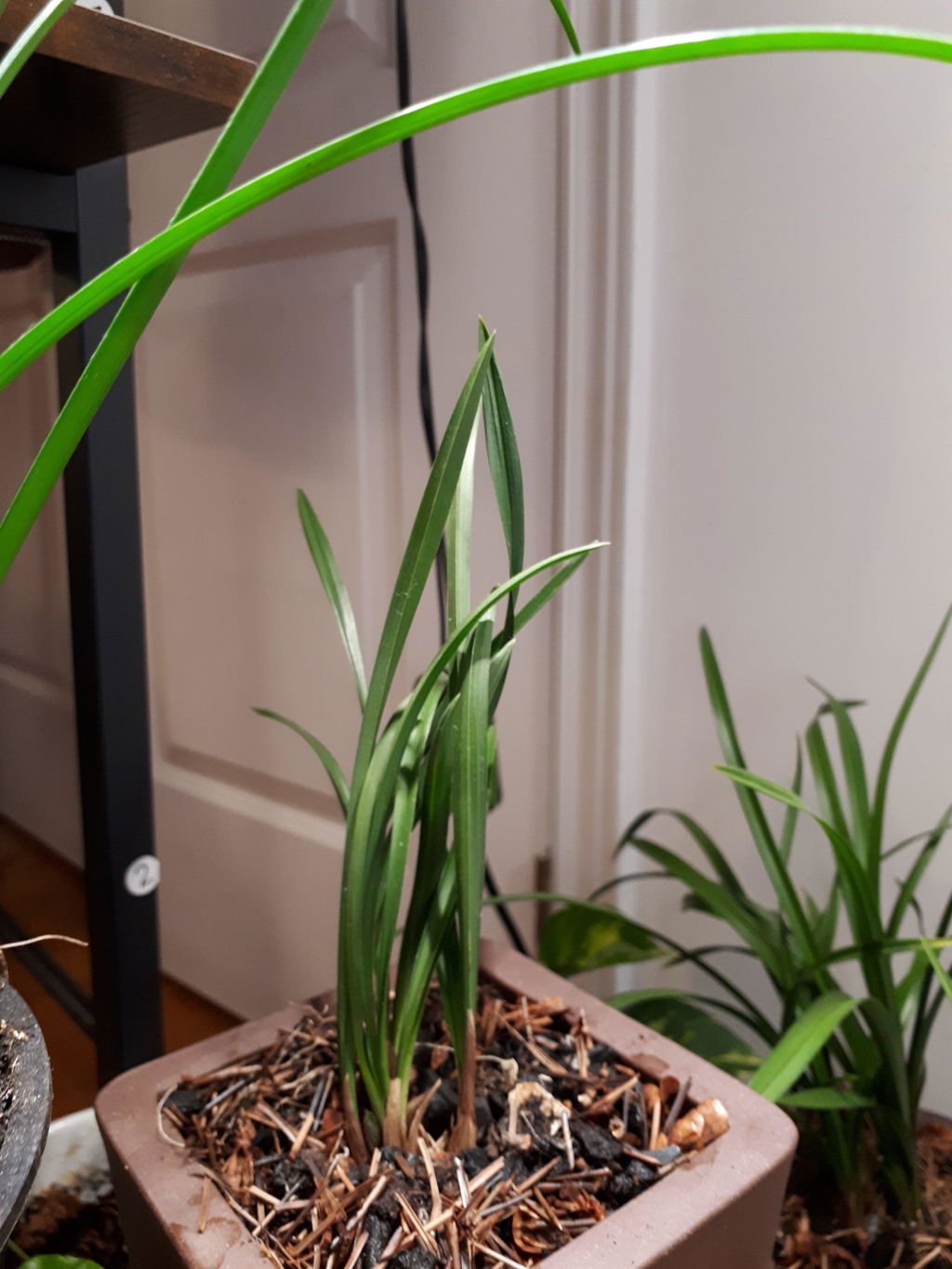
貝利娜蝴蝶蘭(美麗娜)養護指南
Phalaenopsis bellina (Rchb.f.) Christenson — 婆羅洲低地雨林附生蘭,曾長期被當作紫紋蝴蝶蘭(P. violacea)的一個變種,1995年才正式獨立成種,以濃郁的柑橘香氣與多變的花色著稱,是現代蝴蝶蘭雜交育種最重要的香味親本之一

精簡卡
Summary
| 月份 | 1 | 2 | 3 | 4 | 5 | 6 | 7 | 8 | 9 | 10 | 11 | 12 |
|---|---|---|---|---|---|---|---|---|---|---|---|---|
| 日溫°C | 30.0 | 30.2 | 31.4 | 32.4 | 32.7 | 32.6 | 32.5 | 32.6 | 32.1 | 32.0 | 31.7 | 31.0 |
| 夜溫°C | 23.3 | 23.4 | 23.6 | 23.7 | 23.9 | 23.7 | 23.4 | 23.4 | 23.3 | 23.3 | 23.3 | 23.3 |
1884年Reichenbach最初把本種當作紫紋蝴蝶蘭(P. violacea)的一個變種發表,學名是P. violacea var. bellina。直到1995年,Christenson才依花色、花被片形狀與花香化學差異(加上婆羅洲與馬來半島/蘇門答臘的地理隔離)將其提升為獨立種Phalaenopsis bellina。偶爾會看到的「var. borneensis」其實查無此學名——在IPNI、POWO等權威資料庫都找不到——推測可能與園藝俗稱「violacea Borneo Variety」有關,但本文未能找到起源的確切記錄,並非正式的學名組合。分類學者Dalström於2007年曾提出異議,主張應併回violacea,但現行主流分類(POWO)仍接受兩者為獨立種。
f. chloracea、f. caerulea、f. alba是正式發表過的型名,只是現行POWO把它們全部列為異名,沒有被接受的種下分類單元;「var. blue」「var. coerulea」則是位階用錯的栽培圈俗稱,從來不是正式的學名組合;'Borneo Green'、'Red Apple'等則是栽培者自訂的品系(cultivar)名稱,本來就不是分類學位階。買花時可以把這些名字都當成對花色的描述性標籤,不必當成正式的學名位階。
本種是現代蝴蝶蘭商業育種中最重要的香味基因來源之一,據phals.net彙整的資料,至少參與過30個以上的初代雜交(原種×原種)與數百個複合雜交組合。市面上標示為「bellina x violacea」「bellina x tetraspis」的植株,因為violacea與tetraspis在分類學上都是與本種不同的獨立物種,屬於種間雜交,與本種的原生色型分屬不同類別。
貝利娜蝴蝶蘭曾經就是紫紋蝴蝶蘭(P. violacea)的一個變種,直到1995年才被拆分成獨立種,分類學者Dalström於2007年還曾發表文章主張應該併回去。查證這個物種的過程,最有意思的地方反而是一連串「聽起來合理但查無實據」的說法:不管是栽培者口中的升種理由、光照建議,還是色型名稱的分類地位,幾乎每一項都需要重新核對。
從變種到獨立種:升種的理由,與至今仍有人反對的學者
1884年,Reichenbach最初把本種當作紫紋蝴蝶蘭(P. violacea)的一個變種發表,學名是P. violacea var. bellina。這個狀態維持了超過一百年,直到1995年Christenson與Whitten在《Brittonia》期刊發表論文,依花色、花被片形狀與花香化學的差異,將其提升為獨立種Phalaenopsis bellina。兩個物種的地理分布也完全不重疊——本種限於婆羅洲(確切來說是POWO點名的砂拉越),紫紋蝴蝶蘭則分布於馬來半島與蘇門答臘——這組異域分布常被引用為支持獨立種地位的論據之一,不過原始論文裡這一點的論證比重,本文未能取得原文逐一核實。值得誠實指出的是,這場拆分並非沒有異議:分類學者Dalström於2007年在《Selbyana》發表文章,主張把本種重新併回紫紋蝴蝶蘭,理由包括模式標本的野外產地其實不明、而且部分地理型在同一國家內本來就有重疊,地理隔離不該被當作可靠的分類證據。現行主流分類(POWO)仍接受兩者為獨立種,但這提醒讀者:物種的邊界有時候並不像學名看起來那麼篤定。
光照:遮蔭派與明亮派的分歧,查到最後只剩一組中性數字
查證栽培建議時,光照是分歧最明顯的一項。orchidspecies.com形容本種原生棲地「遮蔭」,新加坡國家公園局的資料也建議約70%遮光;但另一批來源——包括引述美國蘭花協會2025年文章的說法——卻指出本種與近緣的紫紋蝴蝶蘭、安汶蝴蝶蘭等同屬一群靠「溫暖與明亮光照」而非低溫觸發開花的類群,暗示偏亮環境可能更有利。兩種說法方向相反,但查到最後,具體的lux數字其實落在約10,800–16,000 lux,跟一般蝴蝶蘭的建議範圍幾乎重疊——也就是說,查無任何證據支持「本種需要比一般蝴蝶蘭更強的光照」這個常見的直覺假設,分歧比較像是對同一組光照範圍的不同形容方式,而不是真正的數據衝突。
不需要秋涼催花:一個與蝴蝶蘭通則相反的開花機制
許多蝴蝶蘭栽培指南會提到「秋天要降溫才能催花」這條通則,但這條通則並不適用於本種。美國蘭花協會2025年一篇文章把本種與紫紋蝴蝶蘭、安汶蝴蝶蘭、及其他幾個近緣種一併歸類為「novelty」類群,並明確指出這群蝴蝶蘭的開花完全不靠低溫觸發,而是靠溫暖環境、明亮光照與足夠的養分儲備——養分與株齡足夠的大株甚至可以全年開花。把「等秋涼」這條通則套用在本種身上,反而可能只是徒增等待的時間,對開花沒有幫助。
冠腐:垂掛生長的智慧,與水管理裡最容易被忽略的細節
本種的致死案例裡,冠部(新葉生長點)積水導致的冠腐是最常被提到的原因之一。這也解釋了為什麼不少栽培者偏好把本種板植、讓葉片自然朝下垂掛——這樣澆水或下雨之後,水分會順著葉片流走,不會積在冠部中央。盆植當然也可行(多用水苔,建議每年換植一次),但盆植時要更刻意避開「正中央澆水、水珠卡在新葉基部」這個常見的澆水習慣。查到的澆水建議本身也存在分歧:有來源建議保持根部微濕、不可全乾;也有來源建議等根系轉為銀白色再澆、寧可略乾一點——本文把這兩種說法都列出來,因為兩者都有來源支持,比較穩妥的折衷做法是澆透後等表層接近乾、根轉銀白再澆,既不要持續濕透,也不要完全乾透。
濃郁柑橘香氣的化學身分:從栽培者的鼻子到氣相層析儀
本種的香氣是最廣受稱讚的特徵,栽培者多形容為柑橘調,也有人形容更接近檸檬。這不只是主觀印象——本種是台灣成功大學團隊的花香研究模式物種之一,多篇分子生物學論文(Hsiao et al. 2006、Chuang et al. 2017、Huang et al. 2021)用氣相層析質譜等技術,鑑定出香氣的主要揮發性成分是單萜類的芳樟醇(linalool)與香葉醇(geraniol),並進一步定出了負責合成這兩種化合物的基因。香氣的釋放也有清楚的時間節律:一天之中以上午約10點到下午4點左右最濃,午夜幾乎測不到;就花朵本身的生命週期而言,開花當天還沒有香氣,約第3天才開始散發,第5天左右達到高峰——但需留意,這項日節律實驗主要以violacea與含本種血統的雜交種為對象,本種本身在這些研究裡主要用於基因分析,節律數據是否完全適用於本種尚待驗證。目前查無任何研究鑑定出本種的野外傳粉者身分。
色型名稱的迷思:你買到的「var. blue」,分類學上其實只是一個俗稱
本種的花色變異度在蝴蝶蘭屬裡數一數二,市面上能看到標示「var. blue」「f. coerulea」「f. chloracea」「f. alba」「'Borneo Green'」「'Red Apple'」等各種色型名稱的植株。查證後發現一個容易被混為一談的細節:這些名稱其實該分成三類。f. chloracea、f. caerulea、f. alba這類型名至少曾經正式發表過,只是現行POWO把它們全部列為異名,沒有一個被接受為正式的種下分類單元(哪怕f. bowringiana曾在1995年與本種同篇論文正式發表,現行POWO依然把它列為異名);「var. blue」「var. coerulea」則連位階都用錯了,是栽培圈的俗稱,從來不是正式的學名組合;'Borneo Green'、'Red Apple'這類則是栽培者自訂的品系(cultivar)名稱,本來就不屬於任何分類學位階。對買家來說,這些名稱其實更接近對花色的描述性標籤,而不是嚴格的學名位階——欣賞花色變化本身完全沒有問題,只是不必把這些名字當成正式分類來理解。
香味基因庫:一株蘭花在雜交育種史上的地位
本種的商業價值,很大一部分來自它在雜交育種史上的地位。據phals.net彙整的資料,本種至少參與過30個以上的初代雜交組合(原種×原種),以及數百個更複雜的多代雜交品系,是現代蝴蝶蘭商業育種裡最重要的香味基因來源之一。市面上常見標示為「bellina x violacea」「bellina x tetraspis」的植株——由於紫紋蝴蝶蘭(P. violacea)與P. tetraspis在分類學上都是與本種不同的獨立物種,這類組合屬於貨真價實的種間雜交,與本篇介紹的原生種及其色型分屬不同類別,選購時請留意分類差異。
保育現況:法律保護存在,但量化的族群數據仍是空白
本種列入CITES附錄II(蘭科全科皆列),國際貿易需相應文件;IUCN紅色名錄目前查無正式評估。地方法律層面,砂拉越《野生動物保護法令》把全部野生蘭科植物列為保護物種,採集、持有或販售須經林業部門核發執照;沙巴州政府也曾表示野生蘭花受《1997年野生動物保育法令》保護、部分物種禁止出口,但本文查無沙巴核發執照制度的對等細節。本種因為是雜交育種的重要香味親本,商業繁殖與組織培養相當普遍,這在一定程度上降低了純粹為滿足市場需求而採集野外植株的壓力——但這只是推論,本文查無量化的野外採集壓力數據。棲地層面,本種偏好的低地河岸林與沼澤林,恰好也是婆羅洲油棕種植與低地伐木壓力最集中的海拔帶,推論棲地破壞是潛在威脅之一,但同樣查無專項研究量化本種的族群下降幅度——誠實地說,這是一個保育資料明顯比栽培資料稀少的物種。
為什麼值得認識這個物種
貝利娜蝴蝶蘭的故事,某種程度上是一個關於「邊界」的故事:它曾經只是另一個物種的變種,花了超過一百年才被拆分出來,而這個拆分至今仍有分類學者不同意;它的色型名稱聽起來正式,實際上大多只是栽培圈的俗稱;它被普遍形容為需要遮蔭,卻又同時是不需要秋涼就能開花的「novelty」類群。如果你準備好接受這些分歧與不確定性,這是一種栽培門檻不算太高、卻能帶來真正濃郁香氣,同時牽連出一整套現代蝴蝶蘭雜交育種史的物種——而冠部不要積水,可能是你唯一需要真正謹記在心的一條規則。
Phalaenopsis bellina is often introduced as "the Bornean cousin of P. violacea" — a phrase worth unpacking, since it literally was a variety of violacea until 1995, and the split still has at least one dissenting taxonomist. What made checking this species interesting wasn't the fragrance story everyone already knows, but how many "obviously true" claims around it — why it was split, how much light it needs, what its color-form names actually mean — turned out to need correction once checked against the record.
From variety to species: the case for splitting it off, and the taxonomist who still disagrees
Reichenbach first described this plant in 1884 as a variety of Phalaenopsis violacea — P. violacea var. bellina. That stood for over a century until 1995, when Christenson and Whitten, writing in Brittonia, elevated it to full species status based on differences in flower color, tepal shape, and floral scent chemistry. The two taxa also occupy entirely separate ranges — this species confined to Borneo (POWO names Sarawak specifically), P. violacea restricted to Peninsular Malaysia and Sumatra — and that disjunct distribution is commonly cited as supporting evidence for the split, though this guide could not verify from the original paper exactly how much weight geography carried in the argument. Worth stating plainly: the split wasn't universally accepted. Dalström, writing in Selbyana in 2007, argued for merging it back into P. violacea, on grounds that the type specimen's actual collection locality is uncertain and that the supposed geographic forms actually overlap within the same countries — meaning geographic separation may not be the clean evidence it's often presented as. POWO currently maintains both as separate species, but the disagreement is a useful reminder that species boundaries aren't always as settled as a binomial makes them look.
Light: shade camp versus bright camp, and a number that turns out unremarkable either way
Light proved to be the most divided topic in the cultivation literature. orchidspecies.com describes the native habitat as shady, and Singapore's NParks recommends roughly 70% shade cloth; but a separate set of sources — including an American Orchid Society 2025 article — groups this species with violacea and the amboinensis alliance as plants whose flowering is driven by warmth and bright light rather than cool temperatures, implying brighter conditions may suit it better. The two camps point in opposite directions, yet the actual lux figures found — roughly 10,800–16,000 lux — sit squarely within the range given for ordinary Phalaenopsis. In other words, there is no evidence supporting the common assumption that this species specifically needs brighter light than typical Phalaenopsis; the disagreement looks more like differing descriptions of the same range than an actual data conflict.
No autumn chill required — a flowering trigger that runs against standard Phalaenopsis advice
Many Phalaenopsis guides repeat the rule that a cooler autumn is needed to trigger spiking, but that rule doesn't apply here. A 2025 American Orchid Society article groups this species with violacea, amboinensis, and other relatives as a "novelty" group whose flowering is not temperature-triggered at all — it's driven by warmth, bright light, and sufficient stored energy, with large, well-grown plants capable of flowering year-round. Applying the "wait for cool weather" rule to this species may simply extend the wait without helping it bloom any sooner.
Crown rot: why a hanging mount is smarter than it sounds
Crown rot — water pooling at the new-growth center of the plant — turns up repeatedly as a leading cause of death for this species. That's part of why many growers prefer mounting it so the leaves hang naturally downward: water from misting or rain runs off instead of collecting at the crown. Potting in sphagnum is equally viable (with an annual repot generally recommended), but potted growers need to be more deliberate about avoiding the common habit of watering straight down the center of the plant, where it can lodge at the base of new leaves. The watering advice itself splits two ways — some sources recommend keeping roots lightly moist and never fully dry, others recommend letting roots turn silvery before watering again. Both have documented support, so this guide lists both rather than picking one, with watering thoroughly and letting the surface approach dry — roots turning silvery — before the next watering as a reasonable middle ground that avoids both permanent sogginess and complete drying out.
The chemistry behind the citrus scent: from a grower's nose to a gas chromatograph
The fragrance is this species' most praised trait, usually described as citrus, sometimes more specifically lemon. That's not just a subjective impression — this species has served as a model organism for floral-scent research by a team at National Cheng Kung University in Taiwan, with multiple molecular biology papers (Hsiao et al. 2006, Chuang et al. 2017, Huang et al. 2021) using gas chromatography-mass spectrometry to identify linalool and geraniol, both monoterpenes, as the dominant volatile compounds, and going on to characterize the genes responsible for synthesizing them. Scent release also follows a clear daily rhythm, peaking roughly between 10am and 4pm and barely detectable at midnight; across the flower's own lifespan, no scent is detectable on the day it opens, with fragrance beginning around day 3 and peaking around day 5 — though it's worth noting the daily-rhythm experiments behind this were conducted mainly on violacea and hybrids carrying this species' genes, with this species itself used mostly for genetic analysis, so whether the rhythm applies exactly the same way here hasn't been separately confirmed. No study identifying this species' wild pollinator was found.
The color-form myth: most of those tags are, taxonomically, just nicknames
This species shows substantial flower-color variation, sold under labels like "var. blue," "f. coerulea" (formally spelled caerulea), "f. chloracea," "f. alba," "'Borneo Green,'" and "'Red Apple,'" among others. Checking the taxonomy turns up a detail easy to miss, and worth separating into two groups: form names like f. chloracea, f. caerulea, and f. alba are at least formally published, but POWO's current treatment lists all of them as synonyms with no accepted infraspecific rank — even f. bowringiana, published in the very same 1995 paper that elevated the species itself. "var. blue" and "var. coerulea," by contrast, use the wrong rank entirely — these are trade nicknames, not valid botanical names at any rank. Named clones like 'Borneo Green' and 'Red Apple' are cultivar names, not taxonomic ranks at all. None of these function as accepted infraspecific taxa — enjoying the color variation is completely fine, there's just no need to read any of these labels as strict botanical classification.
A fragrance gene bank: this species' place in the hybrid breeding record
Much of this species' commercial importance comes from its breeding record. Per a tally compiled by phals.net, it's been used as a parent in more than 30 primary crosses (species × species) and hundreds of more complex multigenerational hybrids, making it one of the most important fragrance parents in modern commercial Phalaenopsis breeding. Plants sold as "bellina x violacea" and "bellina x tetraspis" are a separate case — since both P. violacea and P. tetraspis are accepted species distinct from this one, those are genuine interspecific hybrids, a different category from this species and its color forms.
Conservation status: legal protection exists, but the population numbers remain a blank
This species falls under CITES Appendix II (family-wide), with international trade requiring the corresponding paperwork; no formal IUCN Red List assessment was found. At the state level, Sarawak's Wild Life Protection Ordinance lists all wild orchids as protected, requiring a forestry department permit to collect, hold, or sell; Sabah's state government has likewise stated that wild orchids are protected under the Wildlife Conservation Enactment 1997, with several species barred from export, though this guide found no equivalent detail on Sabah's permitting system. Because this species is such an important breeding parent, commercial propagation and tissue culture are widespread, which plausibly eases pressure to collect wild stock purely to meet market demand — though that's an inference, not something this guide found quantified anywhere. On the habitat side, the lowland riverine and swamp forest this species favors sits within the elevation band most affected by oil palm expansion and lowland logging in Borneo, a plausible threat — but again, no study quantifying an actual population decline for this species was found. Honestly, this is a species where conservation data lags well behind cultivation data.
Why it's worth knowing
In some ways, this species' story is about boundaries: it spent over a century as someone else's variety before being split off, a split at least one taxonomist still disputes; its color-form names sound official but are mostly trade nicknames; it's widely described as shade-loving yet also belongs to a "novelty" group that flowers without any cool-season trigger at all. If you're comfortable with that level of ambiguity, this is a species with a moderate growing curve, genuinely strong fragrance, and a direct line into the breeding history of the modern Phalaenopsis hybrid market — and keeping water out of the crown may be the one rule actually worth memorizing.
Phalaenopsis bellina Care Sheet (Bornean Phalaenopsis)
(Rchb.f.) Christenson — a lowland-rainforest epiphyte from Borneo, long treated as a variety of P. violacea before being split into its own species in 1995, prized for its strong citrus fragrance and highly variable flower color, and one of the most important fragrance parents in modern Phalaenopsis hybridizing
精簡卡
Summary
| Mo. | 1 | 2 | 3 | 4 | 5 | 6 | 7 | 8 | 9 | 10 | 11 | 12 |
|---|---|---|---|---|---|---|---|---|---|---|---|---|
| Day°C | 30.0 | 30.2 | 31.4 | 32.4 | 32.7 | 32.6 | 32.5 | 32.6 | 32.1 | 32.0 | 31.7 | 31.0 |
| Night°C | 23.3 | 23.4 | 23.6 | 23.7 | 23.9 | 23.7 | 23.4 | 23.4 | 23.3 | 23.3 | 23.3 | 23.3 |
Reichenbach first described this plant in 1884 as a variety of P. violacea — P. violacea var. bellina. Not until 1995 did Christenson elevate it to full species status based on flower color, tepal shape, and floral scent chemistry (plus the disjunct Borneo/Peninsular-Malaysia-Sumatra range). The name "var. borneensis" occasionally shows up but doesn't actually exist in the literature — not in IPNI, POWO, or any other authoritative source checked. It may be related to the informal nickname "violacea Borneo Variety," though this guide could not pin down exactly where the name originated; either way, it's not a real taxonomic combination. Taxonomist Dalström dissented in 2007, arguing for merging it back into violacea, though POWO currently keeps both as separate species.
f. chloracea, f. caerulea and f. alba were formally published form names, but POWO's current treatment lists all of them as synonyms with no accepted infraspecific rank; "var. blue" and "var. coerulea" use the wrong rank entirely and were never valid botanical names at any rank; and names like 'Borneo Green' or 'Red Apple' are cultivar (clone) names, which aren't a taxonomic rank at all. Buyers can treat any of these as descriptive trade labels for flower color rather than formal botanical classification.
This species is one of the most important fragrance parents in modern commercial Phalaenopsis breeding, reportedly used in more than 30 primary crosses and hundreds of complex hybrids, per a tally compiled by phals.net. Plants sold as "bellina x violacea" and "bellina x tetraspis" are genuine interspecific hybrids — both P. violacea and P. tetraspis are accepted species distinct from this one — a different category from this species and its color forms.